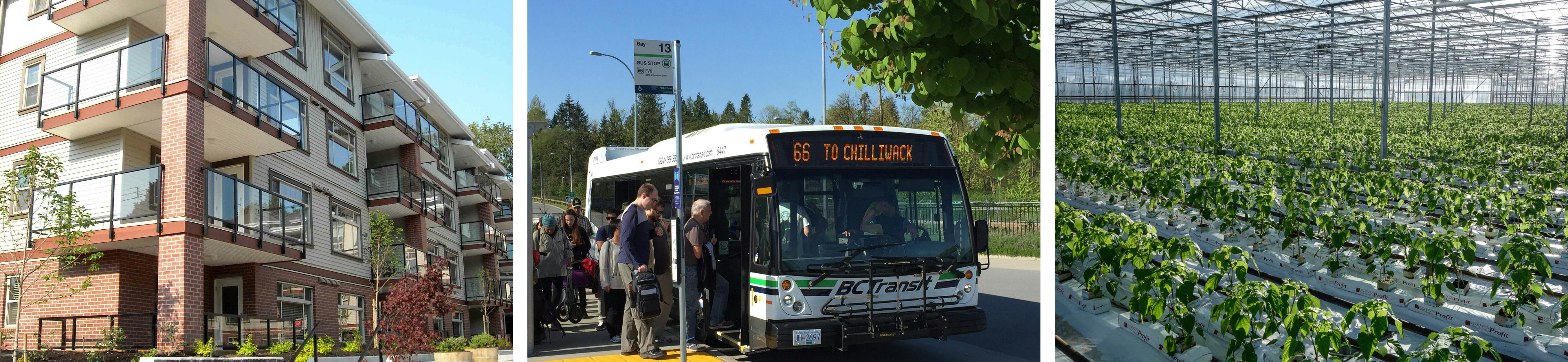
Shape the Regional Growth Strategy
Consultation has concluded
RGS Update is Complete!
Thank you to those who participated in the public engagement process!
Fraser Valley Future 2050 was adopted by the FVRD Board on April 25, 2024. The plan maintains a shared vision for the future, informed by considerable engagement with residents, member municipalities, First Nations, the Province, and neighbouring regional districts.
The updated Regional Growth Strategy includes a greater emphasis on climate action, collaboration among all levels of government, and is a better reflection of the needs, contributions, and significance of the many First Nations whose territories the FVRD is located within.
Some of the more significant updates made to the RGS, aim to:
- Improve collaboration across all levels of government;
- Respect the rights, culture, and self-governance of First Nations communities;
- Include the interests of Indigenous Peoples and local First Nation Communities;
- Improve regional transit and transportation infrastructure;
- Expand public transit and active transportation networks;
- Reduce greenhouse gas emissions produced in the region;
- Expanded policies on housing choice and affordability and homelessness; and
- Improve preparation and response to frequent climate emergencies.
RGS implementation is already underway and will continue to be implemented through ongoing collaboration with member municipalities, adjacent regional districts, the Province, Indigenous communities, other agencies, and the public.
About the Project
The Fraser Valley is growing fast and we need an updated strategy that works for everyone. The FVRD is updating its Regional Growth Strategy (RGS) to reflect new legislation, growing relationships with Indigenous communities, and new challenges facing the region.
Fraser Valley Future 2050 is a high-level policy plan to help guide long-term growth in the region. It covers a wide range of topics, all of which are interconnected, and considers transit, housing, parks, and natural areas, economic development, and environmental issues from a regional perspective.
Regional districts use monitoring programs as part of RGS implementation. The 2023 RGS Monitoring Report and RGS Monitoring website provide important information and context through the evaluation of over thirty indicators based on RGS goals and policies.
What We Heard
Engagement for this project on Have Your Say has now concluded.
From August 3 to October 8, 2021, the FVRD heard from almost 400 residents, employees, business owners, and visitors as part of the public engagement for Phase 2 of the Regional Growth Strategy update, Fraser Valley Future 2050. Check out the public engagement results in this report.

Want to Learn More?
RGS Update is Complete!
Thank you to those who participated in the public engagement process!
Fraser Valley Future 2050 was adopted by the FVRD Board on April 25, 2024. The plan maintains a shared vision for the future, informed by considerable engagement with residents, member municipalities, First Nations, the Province, and neighbouring regional districts.
The updated Regional Growth Strategy includes a greater emphasis on climate action, collaboration among all levels of government, and is a better reflection of the needs, contributions, and significance of the many First Nations whose territories the FVRD is located within.
Some of the more significant updates made to the RGS, aim to:
- Improve collaboration across all levels of government;
- Respect the rights, culture, and self-governance of First Nations communities;
- Include the interests of Indigenous Peoples and local First Nation Communities;
- Improve regional transit and transportation infrastructure;
- Expand public transit and active transportation networks;
- Reduce greenhouse gas emissions produced in the region;
- Expanded policies on housing choice and affordability and homelessness; and
- Improve preparation and response to frequent climate emergencies.
RGS implementation is already underway and will continue to be implemented through ongoing collaboration with member municipalities, adjacent regional districts, the Province, Indigenous communities, other agencies, and the public.
About the Project
The Fraser Valley is growing fast and we need an updated strategy that works for everyone. The FVRD is updating its Regional Growth Strategy (RGS) to reflect new legislation, growing relationships with Indigenous communities, and new challenges facing the region.
Fraser Valley Future 2050 is a high-level policy plan to help guide long-term growth in the region. It covers a wide range of topics, all of which are interconnected, and considers transit, housing, parks, and natural areas, economic development, and environmental issues from a regional perspective.
Regional districts use monitoring programs as part of RGS implementation. The 2023 RGS Monitoring Report and RGS Monitoring website provide important information and context through the evaluation of over thirty indicators based on RGS goals and policies.
What We Heard
Engagement for this project on Have Your Say has now concluded.
From August 3 to October 8, 2021, the FVRD heard from almost 400 residents, employees, business owners, and visitors as part of the public engagement for Phase 2 of the Regional Growth Strategy update, Fraser Valley Future 2050. Check out the public engagement results in this report.

Want to Learn More?
Tell us your story
Whether you grew up in the Fraser Valley or you moved here as an adult, you have a story to tell and we want to hear it! Why do you or your family live in the Fraser Valley? What makes this region a great place to live, work, and play?
-
Share Single mother creates a beautiful home for her family on Facebook Share Single mother creates a beautiful home for her family on Twitter Share Single mother creates a beautiful home for her family on Linkedin Email Single mother creates a beautiful home for her family link
Single mother creates a beautiful home for her family
by ccavanaugh, over 4 years agoI had worked very hard at two jobs and saved some money as a single mom. We lived at the time in Vancouver but where could we afford to buy? Chilliwack. I found a heritage home on a lot large enough to plant fruit trees, have a garden, build a tree fort. It was a dream come true. My kids could walk to school, whatever their age, walk to a fishing hole, walk to the library, walk to a cow field. It was heaven on earth.I had worked very hard at two jobs and saved some money as a single mom. We lived at the time in Vancouver but where could we afford to buy? Chilliwack. I found a heritage home on a lot large enough to plant fruit trees, have a garden, build a tree fort. It was a dream come true. My kids could walk to school, whatever their age, walk to a fishing hole, walk to the library, walk to a cow field. It was heaven on earth. -
Share Grew up here, Raising family here on Facebook Share Grew up here, Raising family here on Twitter Share Grew up here, Raising family here on Linkedin Email Grew up here, Raising family here link
Grew up here, Raising family here
by DJS, over 4 years agoI remember when the Chilliwack mall was built, and the Sheffield plaza was a corn field. This town has changed so much since those days you wouldn’t recognize it now. I used to think, when I was a kid, that Chilliwack was a hole! But then I travelled the world a bit and realized we are truly spoiled to live here. My kids are attending my old high school, and my old school friends are their teachers! Chilliwack is a big town now, but we still have small town ties that keep our communities together. I know we can’t keep... Continue readingI remember when the Chilliwack mall was built, and the Sheffield plaza was a corn field. This town has changed so much since those days you wouldn’t recognize it now. I used to think, when I was a kid, that Chilliwack was a hole! But then I travelled the world a bit and realized we are truly spoiled to live here. My kids are attending my old high school, and my old school friends are their teachers! Chilliwack is a big town now, but we still have small town ties that keep our communities together. I know we can’t keep this place to ourselves, and thanks to the marvels of social media our little “hole” has been discovered. It seems there are so many people flocking to live here, how on earth can we have bidding wars on houses in Chilliwack??? Anyway the main concern I have for the future is public safety. People don’t realize that if you live on the south side of the freeway and your house is on fire, only 2 firefighters can show up. That’s a fact. We rely way too heavily on our auxiliaries, it’s not fair to them, and it’s not safe for us. Promontory needs its own full time fire hall, and we need a full truck in Sardis, Yarrow, not to mention a full time crew in Rosedale.I know I know, fire fighters are expensive. And nobody wants to pay more property tax right? But think about all these new homes being built, all these new dwellings, each one is paying property tax. So believe me the money is there. I’d be willing to shave off some of the parks and Rec budget too if it meant I had a full truck show up to my property fire. Just sayin.
-
Share Admit that Chilliwack is no longer a small town on Facebook Share Admit that Chilliwack is no longer a small town on Twitter Share Admit that Chilliwack is no longer a small town on Linkedin Email Admit that Chilliwack is no longer a small town link
Admit that Chilliwack is no longer a small town
by NFS, over 4 years agoThere needs to be more than two ways to Promontory, more major roads out of the city, extend the parallel roads from Abbotsford all the way to Chilliwack so there are more routes off of Hwy1 when there is the inevitable crash. Add more police officers and clean the streets so that people can feel safe. And for the love of all that is holy please add a Costco.
There needs to be more than two ways to Promontory, more major roads out of the city, extend the parallel roads from Abbotsford all the way to Chilliwack so there are more routes off of Hwy1 when there is the inevitable crash. Add more police officers and clean the streets so that people can feel safe. And for the love of all that is holy please add a Costco.
-
Share Ryder Lake on Facebook Share Ryder Lake on Twitter Share Ryder Lake on Linkedin Email Ryder Lake link
Ryder Lake
by c_joy, over 4 years agoWe live in the beautiful mountainous farming community of Ryder Lake. We love the peace and quiet and the beautiful forests and animals. We farm goats That we use for milk and meat and we have a herd of Angus cows. Our LGD protects all our animals which enables us to live happily with wild creatures. Our son is building a home to live here with us and help us farm as we age. We also make lots of small hay bales for sale and to winter our own herds. It is a wonderful life that we hope to pass... Continue readingWe live in the beautiful mountainous farming community of Ryder Lake. We love the peace and quiet and the beautiful forests and animals. We farm goats That we use for milk and meat and we have a herd of Angus cows. Our LGD protects all our animals which enables us to live happily with wild creatures. Our son is building a home to live here with us and help us farm as we age. We also make lots of small hay bales for sale and to winter our own herds. It is a wonderful life that we hope to pass on to our children. We are attempting to help our son get into the housing market which is crazy in Chilliwack hence we are sharing this land. -
Share Less traffic on Facebook Share Less traffic on Twitter Share Less traffic on Linkedin Email Less traffic link
Less traffic
by Amanda, over 4 years agoWe Moved from Langley out to mission because we were looking for property. We found 5 acres eight years ago at a price we could afford, and a house we could rely on as an investment 30 years down the road. Part of our retirement plan.
While that was one factor, we were also looking for less traffic. Langley’s traffic problem even in the late 90s was horrendous and while there are some improvements it is still bad. While my commute has gotten better (I now work and live in mission) my partners is worse it was 35 minutes and... Continue readingWe Moved from Langley out to mission because we were looking for property. We found 5 acres eight years ago at a price we could afford, and a house we could rely on as an investment 30 years down the road. Part of our retirement plan.
While that was one factor, we were also looking for less traffic. Langley’s traffic problem even in the late 90s was horrendous and while there are some improvements it is still bad. While my commute has gotten better (I now work and live in mission) my partners is worse it was 35 minutes and is now 50 minutes each way to work. More industry will need to come to Mission/Abbotsford in order to improve his commute and employment opportunities.
we chose to move to mission for affordability, traffic, privacy. The schools in mission have a bad reputation I’m hoping that the high school will be okay as my oldest starts soon the elementary schools and middle schools have been great. I hope a new high school is built in the near future and good planning will result in a new high school in the silverdale development before Mission secondary is busting at the seams.
At the time we had to remain in the Fraser Valley due to family obligations. But mission was attractive because it has better air quality than Chilliwack, lower housing costs than Abbotsford and Langley. We knew it was a growing community and it would not have all the services that we would want but it was a sacrifice we were willing to make. I would like more playgrounds, established walking hiking trails, more community programs and safer multi-use roadways.I love the mountains and the forests of mission! whatever development plans for silverdale there should be large swathes of greenways and forest left in tact that is managed by our indigenous community partnerships. For both economic and environmental sustainability. Silverdale needs a long term plan that has both high density, and low density that reflects the needs of the environment and the community. For the low density lower property taxes for those who maintain forests and wooded areas. Rather than cleared land.
We need to plan for city development long term traffic/busses/trams/ trains or other transit methods. Multiple community hubs that make walking distance an option for daily shoppers. Currently 98% of the residents of mission need to rely on a vehicle/taxi or bus to do their shopping.
-
Share Moving eastwards and eastwards for lifestyle and sense of community. on Facebook Share Moving eastwards and eastwards for lifestyle and sense of community. on Twitter Share Moving eastwards and eastwards for lifestyle and sense of community. on Linkedin Email Moving eastwards and eastwards for lifestyle and sense of community. link
Moving eastwards and eastwards for lifestyle and sense of community.
by Terry W, over 4 years agoI was born and raised in New Westminster, in a time where New Westminster was a bedroom community of Vancouver and Skytrain was not even in the most far-reaching futurist's thoughts. It was a busy community but had a sense of identity with families attending festivals and events and knowing their neighborhoods. The regions were built on the concept of families and jobs being reasonably close by. Workers seldom had multiple-hour daily commutes. Greenspace was plentiful, even if it was not a park, it was vacant or undeveloped areas that held natural buffers to the hectic pace of daily life... Continue readingI was born and raised in New Westminster, in a time where New Westminster was a bedroom community of Vancouver and Skytrain was not even in the most far-reaching futurist's thoughts. It was a busy community but had a sense of identity with families attending festivals and events and knowing their neighborhoods. The regions were built on the concept of families and jobs being reasonably close by. Workers seldom had multiple-hour daily commutes. Greenspace was plentiful, even if it was not a park, it was vacant or undeveloped areas that held natural buffers to the hectic pace of daily life. Development was allowed to grow virtually unchecked until the ALR was brought in to conserve farmland and halt the rubberstamping of almost any development proposed. Through all this the concept developed of densification. A wonderful idea that if implemented well, should in theory free up room for community spaces. However, the densification in the case of New Westminster was not well thought out, in return for developer's fees, the city grew vertically, without any amenities and with no thought as to the after-effects. People were packed in like lemmings and with that, cars, visitors, visitors cars and more and more people. Naturally, they build in space for residents' cars in the buildings but imagine hundreds of units and the potential for all the added crowds when friends drove over to visit . Each visitor looking for a parking spot, finding none as the developers and city either did not care or didn't consider it. Spillover went into single-family neighborhoods or wherever a spot to park could be found. Then Skytrain came in, and the commuters were looking for park and ride facilities, where there were few in any . They would park anywhere they could near a bus stop and hop on a bus to get to the station. Residents were greeted by lines of cars on their streets, sometimes creeping over into driveways. Eventually, urban sprawl resulted in New Westminster becoming the parking lot of the lower mainland . I moved my family to Maple Ridge to get away. Life was going well until I saw Maple Ridge start copying the master plan so sadly dropped on New Westminster . I then came to Mission. Here, a sense of community still persists. I can enjoy going out and visiting the local shops without having to listen to a traffic report to plan my route. I can see valleys and mountains without having to circle around high rises and driving to a viewpoint in some select park. I hope that the people here don't follow Maple Ridge and New Westminster in their OCP . We still have a chance to build smartly, creatively, and with an eye to keeping nature close to our hearts. -
Share Designate Stave estuary including Silvermere island as parkland on Facebook Share Designate Stave estuary including Silvermere island as parkland on Twitter Share Designate Stave estuary including Silvermere island as parkland on Linkedin Email Designate Stave estuary including Silvermere island as parkland link
Designate Stave estuary including Silvermere island as parkland
by Tracy, over 4 years ago
I have lived in Mission for over 20 years and each year I am blown away by the spawn of wild salmon at the lower Stave river estuary. In addition to the salmon, the wetlands of Silvermere lake, support endangered species including Western painted turtles and hundreds of bald eagles, some of whom nest on Silvermere Island. If the region is going to increase its population, we need to protect biodiversity hot spots such as the lower Stave river including Silvermere lake and Silvermere island. The entire area needs to be designated as conservation area/parkland.
-
Share Freeway Congestion is Horrible! on Facebook Share Freeway Congestion is Horrible! on Twitter Share Freeway Congestion is Horrible! on Linkedin Email Freeway Congestion is Horrible! link
Freeway Congestion is Horrible!
by JeanK, over 4 years agoI moved to Chilliwack 5 years ago and love the area very much. The pace is slower, people are friendly and there are lots of shops & services and outdoor spaces. I have a vehicle so do not take transit and find that getting around the City is not much of a problem. But I have to commute from Chilliwack to Coquitlam & back quite often and I find the freeway almost always backed up. Going west it is usually from Hwy 11 in Abbotsford and onwards, especially the 264th area and coming east it is usually backed up between... Continue readingI moved to Chilliwack 5 years ago and love the area very much. The pace is slower, people are friendly and there are lots of shops & services and outdoor spaces. I have a vehicle so do not take transit and find that getting around the City is not much of a problem. But I have to commute from Chilliwack to Coquitlam & back quite often and I find the freeway almost always backed up. Going west it is usually from Hwy 11 in Abbotsford and onwards, especially the 264th area and coming east it is usually backed up between 216th in Langley and Abbotsford Highway 11 and even as far as the No. 3 Road Exit during the summertime. A HOV lane in both directions that goes from 216th to Hwy 11 would certainly help somewhat. It would be better if there was a HOV lane that went all the way to Chilliwack. We also need a sign board to give advance notice when an accident has occurred so we have time to take an alternate route if available - instead of getting stuck sitting on the Freeway with no way to get off. -
Share I want to park my car... on Facebook Share I want to park my car... on Twitter Share I want to park my car... on Linkedin Email I want to park my car... link
I want to park my car...
by MM, over 4 years ago... forever if possible. there's nothing that makes a holiday more fun or a community more vibrant than happy crowds of people on the street. Pedestrian malls and walkable business and entertainment districts are where it's at. And trips to the city (pick one, any one, in the lower mainland) are no fun if you have to drive and park and then drive home again. I'm up in Hope and admittedly pretty car dependent but I do take regional transit when I can and I have travelled all the way to YYC on one occasion. It took forever but it... Continue reading... forever if possible. there's nothing that makes a holiday more fun or a community more vibrant than happy crowds of people on the street. Pedestrian malls and walkable business and entertainment districts are where it's at. And trips to the city (pick one, any one, in the lower mainland) are no fun if you have to drive and park and then drive home again. I'm up in Hope and admittedly pretty car dependent but I do take regional transit when I can and I have travelled all the way to YYC on one occasion. It took forever but it was doable and for that I thank the FVRD. Let's really lobby hard and plan for more transit infrastructure. those trains in Mission are cool but they're of minor value in terms of an overall system because of the limited schedule they operate under. I honestly think that rapid transit and local transit options, integrated with biking routes and racks, is the key to a happier healthier, more affordable and greener Fraser Valley culture. I want to live in THAT future.
Signup Banner
Who's Listening
-
Planner
TAEmail stratplan@fvrd.ca
Timeline
-
Background research and project launch
Shape the Regional Growth Strategy has finished this stage -
Phase 1 engagement
Shape the Regional Growth Strategy has finished this stage -
Draft plan 1
Shape the Regional Growth Strategy has finished this stage -
Referrals
Shape the Regional Growth Strategy has finished this stage -
Plan refinement
Shape the Regional Growth Strategy has finished this stage -
Draft plan 2
Shape the Regional Growth Strategy has finished this stage -
Phase 2 engagement
Shape the Regional Growth Strategy has finished this stage -
Plan refinement
Shape the Regional Growth Strategy has finished this stage -
Final draft
Shape the Regional Growth Strategy has finished this stage -
Acceptance and formal adoption
Shape the Regional Growth Strategy is currently at this stage
FAQs
- What is a Regional Growth Strategy?
- What does a Regional Growth Strategy NOT do?
- Does the FVRD currently have a Regional Growth Strategy?
- How is the Regional Growth Strategy implemented?
- Has there been Indigenous engagement?
- Are First Nations Reserves subject to the RGS or the Agricultural Land Reserve Act?
- Does an RGS require provincial approval?
- How is the RGS adopted?
- What is a regional context statement
Related Documents
-
FINAL RGS Fraser Valley Future 2050 - Feb 2024.pdf (40.8 MB) (pdf)
-
2023 RGS Monitoring Report (6.24 MB) (pdf)
-
2019 RGS Monitoring Report (3.89 MB) (pdf)
-
FVRD RGS Fact Sheets (7.05 MB) (pdf)
-
United Nations Declaration on the Rights of Indigenous Peoples (150 KB) (pdf)
-
FVRD Clean Economy Study (2.01 MB) (pdf)
-
FVRD Outdoor Recreation Economic Impact Analysis 2020 (5.42 MB) (pdf)
-
FVRD Electoral Areas Housing Needs Report (9.08 MB) (pdf)
-
2020 FVRD Homeless Count and Survey Report (1.56 MB) (pdf)
-
draft FVRD Air Quality Management Plan (33.9 MB) (pdf)
-
FVRD Regional Trip Diary 2014 (1.99 MB) (pdf)
-
FVRD Air Quality Management Plan 2021 (3.75 MB) (pdf)
-
FVRD Rural Broadband Connectivity Study 2020 (25.7 MB) (pdf)
-
Freshet Flooding Agriculture Impacts 2017 (1.5 MB) (pdf)
-
Fraser Valley Agriculture Climate Adaptation Strategy 2018 (5.21 MB) (pdf)
-
Fraser Valley Agriculture Climate Adaptation Strategies 2015 (2.48 MB) (pdf)
-
RGS Update - Public Engagement Report (11.9 MB) (pdf)
-
Staff Report - Indigenous Engagement (93.5 KB) (pdf)