Project Overview
Flood governance in the Hatzic Watershed is undergoing a review. The 2021 Atmospheric River Event emphasized the urgent need for more coordinated flood management, especially as flooding in the Hatzic Valley becomes more frequent and severe.
In response to this need, the Hatzic Watershed Stewardship Team is working together to imagine a new partnership model that could address flood management and the provision of flood services.
Over the past few years, the Hatzic Watershed Stewardship Team has included individuals from Fraser Valley Regional District, Leq’a:mel First Nation, Dewdney Area Improvement District, Ministry of Agriculture, Ministry of Environment, Ministry of Transportation and Transit, Ministry of Water, Land and Resource Stewardship, and Ministry of Emergency Management and Climate Readiness. The group has been working together to put forward recommendations to the Province on a potential flood governance model and service-delivery function.
Hatzic Flood Governance Today
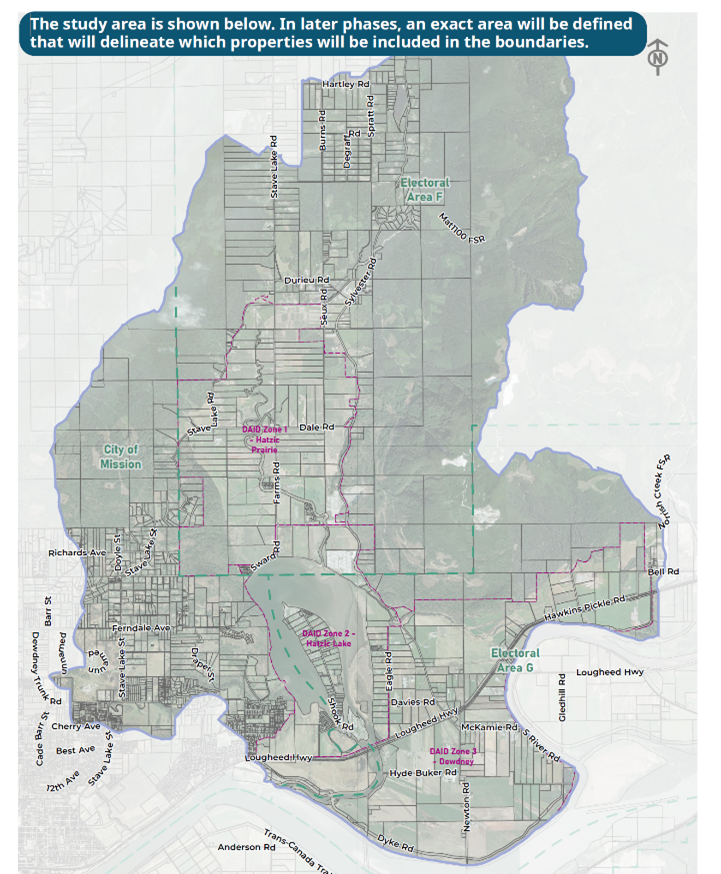 The Dewdney Area Improvement District (DAID) has long served as the diking authority for the Hatzic Valley, managing lake levels, the pump stations, and other essential flood protection infrastructure.
Through recent years — including the 2021 Atmospheric River — DAID has felt the strain of managing flood challenges on its own. The funds raised through local flood taxes are not enough to keep up with maintenance or prepare for larger future events. While a single agency can design and deliver a limited flood service, effective flood management requires many parties working together in an organized and formalized way.
In the Hatzic Valley, the partial involvement of multiple agencies has made coordination challenging, leading to delays, service gaps, and inconsistent responses across the watershed.
The current partnership model isn’t functioning at a scale that meets local, regional, or provincial goals. DAID and the Hatzic Watershed Stewardship Team see greater opportunity in working collaboratively across the watershed — sharing responsibilities, building partnerships, and securing the resources needed to better protect the valley together.
If we want more local solutions, we need local, collaborative leadership.
The Team is working to imagine a partnership model that could:
- Secure funding from local, provincial, and federal sources.
- Develop flood management systems and infrastructure that make the Valley more resilient in the short, medium, and long term.
- Maintain clear communication among all partners.
- Create effective maintenance plans.
- Promote sustainable practices throughout the watershed.
- Align agencies and governments to focus efforts and contribute their unique strengths.
Why are we doing this work now?
- The Current Approach is outdated: DAID has been managing flood infrastructure in the Hatzic Valley since the 1960s. Because of funding restraints, a lack of capacity, and more severe/frequent flooding, this approach no longer works. Many issues are also outside of DAID’s scope alone (i.e., upper watershed).
- Recovery funds are running out: The funding from the 2021 Atmospheric River is almost gone, and it’s getting harder to access new grants. To improve our chances of getting future funding, we need a strong, well-organized system with clear goals and priorities.
- Indigenous knowledge must be centered: For decades, flood planning in this area has happened without input from local First Nations. Moving forward, it’s essential that Indigenous leadership and their deep knowledge of the land are included.
- The Hatzic Lake Management Plan has been tricky to put into action: No one group has had the power or resources to fully carry out the recommendations in this management plan. To move forward, we need to work together and take a united approach to implement the plan.
- We need to plan beyond the Lake: Most of the planning has focused just on Hatzic Lake, but to really reduce flood risks and impacts, we need to look at the entire watershed—upstream and downstream—and deal with problems at their source and where they are more manageable.
What options are the Hatzic Watershed Stewardship Team considering?
Option | Potential Benefits | Potential Drawbacks |
Option 1: Keep the Dewdney Area Improvement District operating as it does today, with the same funding methods and responsibilities for flood protection. | - Requires the lowest level of effort to maintain
- No changes to taxes or fees
- Familiar and well-understood by residents and landowners
| - Limited resources make it hard to meet maintenance, coordination, and service expectations
- Narrow scope limits the ability to address watershed-wide flood risks
- Does not incorporate Leq’á:mel First Nation knowledge and expertise
- Lacks access to stable regional funding
- Least likely to meaningfully reduce flooding risk
|
Option 2: Transfer DAID’s assets, responsibilities, and funding to the Fraser Valley Regional District through a provincially approved process. | - Access to FVRD professional staff, engineering expertise, and stronger administrative systems
- Better integration with land use, development, and communications
- Greater eligibility for grant funding to support future upgrades
| - Does not address flooding at the full watershed scale
- Does not incorporate Leq’á:mel First Nation knowledge and expertise
- Flood causes and impacts may remain fragmented across jurisdictions
|
Option 3: Convert DAID to a Fraser Valley Regional District service and add a second, watershed-wide service area – with partners - to cover the full Hatzic Watershed. | - Enables early risk identification and proactive flood planning across the whole watershed
- Strengthens coordination with Leq’á:mel First Nation’s Guardians Program and the City of Mission
- Improves monitoring, data sharing, and access to grant funding
- Supports long-term planning and ecosystem restoration
- Creates opportunities for shared funding and regional advocacy
| - Requires high levels of coordination across multiple jurisdictions and agencies
- Shared governance structure would be complicated and time-intensive to establish
- Would introduce changes to taxation and/or fees, including a watershed-wide levy
|
We’re seeking your thoughts on all three options — how they might work, and what matters most to you. You’ll see more detail on Option 3 because it’s newer and different, and it has been the main focus of recent Hatzic Watershed Stewardship Team’s engagement. All options are on the table. For more details on the options being proposed, download the Project Overview Package and Open House Boards, or through the Related Documents tab.
Get Involved
This information is being shared for discussion and engagement purposes. We want to know your thoughts on all three options.
There are two opportunities to provide your feedback:
- Join us for an informal, drop-in open house to learn about the options being considered. Project team members will be available throughout the evening to answer questions, listen to your ideas, and hear what matters most to you. There will be no formal presentation or scheduled remarks—come by Dewdney Elementary February 5th 2026, from 6:00 pm – 8:30 pm.
- Leave a comment or question on this webpage.
Project Overview
Flood governance in the Hatzic Watershed is undergoing a review. The 2021 Atmospheric River Event emphasized the urgent need for more coordinated flood management, especially as flooding in the Hatzic Valley becomes more frequent and severe.
In response to this need, the Hatzic Watershed Stewardship Team is working together to imagine a new partnership model that could address flood management and the provision of flood services.
Over the past few years, the Hatzic Watershed Stewardship Team has included individuals from Fraser Valley Regional District, Leq’a:mel First Nation, Dewdney Area Improvement District, Ministry of Agriculture, Ministry of Environment, Ministry of Transportation and Transit, Ministry of Water, Land and Resource Stewardship, and Ministry of Emergency Management and Climate Readiness. The group has been working together to put forward recommendations to the Province on a potential flood governance model and service-delivery function.
Hatzic Flood Governance Today
The Dewdney Area Improvement District (DAID) has long served as the diking authority for the Hatzic Valley, managing lake levels, the pump stations, and other essential flood protection infrastructure.
Through recent years — including the 2021 Atmospheric River — DAID has felt the strain of managing flood challenges on its own. The funds raised through local flood taxes are not enough to keep up with maintenance or prepare for larger future events. While a single agency can design and deliver a limited flood service, effective flood management requires many parties working together in an organized and formalized way.
In the Hatzic Valley, the partial involvement of multiple agencies has made coordination challenging, leading to delays, service gaps, and inconsistent responses across the watershed.
The current partnership model isn’t functioning at a scale that meets local, regional, or provincial goals. DAID and the Hatzic Watershed Stewardship Team see greater opportunity in working collaboratively across the watershed — sharing responsibilities, building partnerships, and securing the resources needed to better protect the valley together.
If we want more local solutions, we need local, collaborative leadership.
The Team is working to imagine a partnership model that could:
- Secure funding from local, provincial, and federal sources.
- Develop flood management systems and infrastructure that make the Valley more resilient in the short, medium, and long term.
- Maintain clear communication among all partners.
- Create effective maintenance plans.
- Promote sustainable practices throughout the watershed.
- Align agencies and governments to focus efforts and contribute their unique strengths.
Why are we doing this work now?
- The Current Approach is outdated: DAID has been managing flood infrastructure in the Hatzic Valley since the 1960s. Because of funding restraints, a lack of capacity, and more severe/frequent flooding, this approach no longer works. Many issues are also outside of DAID’s scope alone (i.e., upper watershed).
- Recovery funds are running out: The funding from the 2021 Atmospheric River is almost gone, and it’s getting harder to access new grants. To improve our chances of getting future funding, we need a strong, well-organized system with clear goals and priorities.
- Indigenous knowledge must be centered: For decades, flood planning in this area has happened without input from local First Nations. Moving forward, it’s essential that Indigenous leadership and their deep knowledge of the land are included.
- The Hatzic Lake Management Plan has been tricky to put into action: No one group has had the power or resources to fully carry out the recommendations in this management plan. To move forward, we need to work together and take a united approach to implement the plan.
- We need to plan beyond the Lake: Most of the planning has focused just on Hatzic Lake, but to really reduce flood risks and impacts, we need to look at the entire watershed—upstream and downstream—and deal with problems at their source and where they are more manageable.
What options are the Hatzic Watershed Stewardship Team considering?
Option | Potential Benefits | Potential Drawbacks |
Option 1: Keep the Dewdney Area Improvement District operating as it does today, with the same funding methods and responsibilities for flood protection. | - Requires the lowest level of effort to maintain
- No changes to taxes or fees
- Familiar and well-understood by residents and landowners
| - Limited resources make it hard to meet maintenance, coordination, and service expectations
- Narrow scope limits the ability to address watershed-wide flood risks
- Does not incorporate Leq’á:mel First Nation knowledge and expertise
- Lacks access to stable regional funding
- Least likely to meaningfully reduce flooding risk
|
Option 2: Transfer DAID’s assets, responsibilities, and funding to the Fraser Valley Regional District through a provincially approved process. | - Access to FVRD professional staff, engineering expertise, and stronger administrative systems
- Better integration with land use, development, and communications
- Greater eligibility for grant funding to support future upgrades
| - Does not address flooding at the full watershed scale
- Does not incorporate Leq’á:mel First Nation knowledge and expertise
- Flood causes and impacts may remain fragmented across jurisdictions
|
Option 3: Convert DAID to a Fraser Valley Regional District service and add a second, watershed-wide service area – with partners - to cover the full Hatzic Watershed. | - Enables early risk identification and proactive flood planning across the whole watershed
- Strengthens coordination with Leq’á:mel First Nation’s Guardians Program and the City of Mission
- Improves monitoring, data sharing, and access to grant funding
- Supports long-term planning and ecosystem restoration
- Creates opportunities for shared funding and regional advocacy
| - Requires high levels of coordination across multiple jurisdictions and agencies
- Shared governance structure would be complicated and time-intensive to establish
- Would introduce changes to taxation and/or fees, including a watershed-wide levy
|
We’re seeking your thoughts on all three options — how they might work, and what matters most to you. You’ll see more detail on Option 3 because it’s newer and different, and it has been the main focus of recent Hatzic Watershed Stewardship Team’s engagement. All options are on the table. For more details on the options being proposed, download the Project Overview Package and Open House Boards, or through the Related Documents tab.
Get Involved
This information is being shared for discussion and engagement purposes. We want to know your thoughts on all three options.
There are two opportunities to provide your feedback:
- Join us for an informal, drop-in open house to learn about the options being considered. Project team members will be available throughout the evening to answer questions, listen to your ideas, and hear what matters most to you. There will be no formal presentation or scheduled remarks—come by Dewdney Elementary February 5th 2026, from 6:00 pm – 8:30 pm.
- Leave a comment or question on this webpage.
 2026-01-23 Project Overview- Open House Boards.pdf (9.29 MB) (pdf)

I am in favour of option #3.
Option two works,
Looks like the best choice.
I share the thoughts of Brent Hall:
"Timing is critical. We can't afford another flood like 2021. First step should be immediately getting CP to the table. There is ample evidence that they and all other bodies have been aware of the limits of the culverts. 1991/1992 Hatzic prairie drainage study even shows images of a potential solution yet nothing was done. The 2019/2020 Hatzic and area Management plan again indicated the issue. When the 2021 flood ocurred it was again pointed put to all stakeholders through meetings, letters, facebook groups etc. This is a well known issue. As I said...the evidence is clear and this needs immediate action. I also understand there is headwater and siphoning issues with the pumps, and the flow to the pumps can be affected in numerous ways before they can operate. This should be rectified immediately also. There should also be some systems in the event of a power outage. If the pumps don't work...I cant even imagine that outcome. These are the most critical things right away. With regards to governance; Option 3 sounds good, but maybe first steps would be option 2 to get the FVRD immediately in control and have access to more resources and potential funding. Then...work towards option 3. Option 2 would likely be successful with residents while option 3 is a long shot (despite making sense...convincing land owners to pay more the way it is suggested could or would be a challenge and just add a lot of time without things getting done). At the end of the day though option 3 makes sense. We all need to be in this together. Land owners have experienced tremendous growth in the value of theor properties (most anyhow), and so giving a little back to protect the whole area could on its own improve values even further by having a solid protection plan in place.
I support Option 2 and would support a referendum for Option 3 once a budget and costing is done for that option.
The problem is that the culvert under the Highway and the tracks are too small to handle the flow during rain season! Needs to involve CP and the Provincial Government to replace them, yes, it will be very expensive but I don't see any alternatives! Too simplistic? I don't know!
Thank you for putting this document together and for the open house. It is clear to all the residence living in the Hatzic Valley that the threat of flood and consequently property damage is not only a future possibility but a currant reality. With the extreme weather events we are experiencing year after year and the logging that continues on the slopes above the valley we need to pull all resources together and manage the waterways and the sediment that cascades down into the valley bottom.At first glance it may only effect a portion of the properties but in reality the whole Valley is effected . I would like to see option 3 to come into effect . I am not in the flood zone and am prepared to pay more taxes to have this on going problem managed well . It will only work if all the agencies work together. Also I am wondering why the MOF not included since they are the root cause of the problem.
Thank you
Thank you for the opportunity to add comments and for the work that has been done to address ongoing issues within the Hatzic valley. I would like to see the Hatzic valley watershed be viewed as a whole from the mountain peaks to the Fraser river. The impact on the watershed from activities on both private and public land needs to be considered. With this in mind, I would choose option #3 as it offers a comprehensive framework that includes FN input. I would also emphasize that previous studies and research be included so that funding can be used immediately towards remediating issues. Please address this valley collaboratively and not as separate groups working in silos. Thank you.
I would support option 3 going forward
Option 1 "Leaving it as is" is outdated and funding does not cover this model. It is long past time for change.
Option 2 "Convert to FVRD" the proper level of governance is with the FRVD and should have been transferred years ago.
Option 3 "Convert and add more cost" lets not add another layer of bureaucracy and cost. We do not need to add more governanceor spend more of our limited tax dollars. Give the FVRD a chance.
Option 2 is the only choice for me.
Timing is critical. We can't afford another flood like 2021. First step should be immediately getting CP to the table. There is ample evidence that they and all other bodies have been aware of the limits of the culverts. 1991/1992 Hatzic prairie drainage study even shows images of a potential solution yet nothing was done. The 2019/2020 Hatzic and area Management plan again indicated the issue. When the 2021 flood ocurred it was again pointed put to all stakeholders through meetings, letters, facebook groups etc. This is a well known issue. As I said...the evidence is clear and this needs immediate action. I also understand there is headwater and siphoning issues with the pumps, and the flow to the pumps can be affected in numerous ways before they can operate. This should be rectified immediately also. There should also be some systems inbthe event of a power outage. If the pumps dont work...I cant even imagine that outcome. These are the most critical things right away. With regards to governance; Option 3 sounds good, but maybe first steps would be option 2 to get the FVRD immediately in control and have access to more resources and potential funding. Then...work towards option 3. Option 2 would likely be successful with residents while option 3 is a long shot (despite making sense...convincing land owners to pay more the way it is suggested could or would be a challenge and just add a lot of time without things getting done). At the end of the day though option 3 makes sense. We all need to be in this together. Land owners have experienced tremendous growth in the value of theor properties (most anyhow), and so giving a little back to protect the whole area could on its own improve values even further by having a solid protection plan in place.
FVRD Reps,, select OPTION 1----DAID needs specific advice from other "flood prevention experts" with advisory assistance and liaison with their Area FVRD REP. to manage their future improved flood protection focus; a "Highly trained and experienced Engineer" needs to be hired who has "Flood control expertise with the co-ordinating of weather patterns specifically for the very high rainfall in this Hatzic Island/Prairie/ Valley situation for adjusting the 'Pumps' correctly to avoid more flooding to the Island and Prairie. The REPORT DATA presented by a writer on behalf of DAID IS WITH GREAT ERRORS AND MISINFORMATION. The person has "lacked integrity of correct facts" to convey to all concerned about the multi COMPLEX flooding issues. The person has neglected to include the " Royal Rhodes University Students" project for which they presented, as well on 'ZOOM', the factual listing of a detailed Flood Management Plan. A local First Nation Engineer from our near by neighbours arranged for this University project in liaison with DAID as I understood. The Factual report compiled the need for greater liaison with all agencies involved in Flood prevention. There are about 20 to 30 reports on flooding issues regarding our Hatzic Valley. These reports detail problems from the Ministry of Forestry permits not caring about this wilderness ecosystem environment for sustainability. So LOGGING Clearcuttting activities continue into 2026 affecting ongoing FLOODING to creeks, many with DFO THREATENED STATUS, Mud and Rock slides to Hatzic Prairie and the Upper Hatzic Valley. None of the recommendations by the experts have not been completed to stop MOF clearcutting rain water run-off into now 2026.
FVRD Reps. need to emphatically liaise with MoF Ministry to legally stop the clearcutting flood effects and with DFO and MOE to safeguard these areas to become sustainable management. We need multI changes to preserve our MOF Crownlands to help deter future worst "Atmospheric Rivers" increased damage to all of the FVRD areas.
Different funding sources have been found to manage debris /flooding clearing to the creeks such as Eng, Cascade, Pattison, Legacy etc.
DAID needs to purchase and set up a 'high end weather electronic/internet data collection' real soon. Fact, I understand monies may be available from a First Nations liaison to purchase such a 'rainfall water moniter internet data base!
Cascade Creek area property owners already pay into funds for their " flooding prevention" with their dike maintenance etc. Their monies must not be shared into the other Options.
Therefore FVRD EASC Reps., I Request you to vote for Option 1!
In my opinion Option #1 is "Do nothing" whereas Option #2,does not address some of the sources of the problems caused by activity in the watershed nor involve the indigenous community and Option #3 does address the sources of some of the problems and input from the indigenous community. So I support Option#3.
Those up above the flats may not be subject to flooding but some conduct, like logging and soil removal or deposits can negatively impact those in the valley below. We have had some 33 studies done in relation to this valley over the years and in recent times have lots of evidence by way of photos/videos and witness statements that have observed such consequences below, particularly from logging and soil deposits.
As a matter of common law -if you do something on your property that negatively affects your neighbors quiet enjoyment of their property you commit what is called a "nuisance" and can be held liable for any damages caused.
In my opinion it is in the interests of those of us not directly impacted by the flooding to support limiting conduct in and managing our watershed that can cause damage to our neighbors below. They pay fees for both while we only pay the Watershed fee.
I understand a referendum would be required for either option #2 or #3 and would recommend a public hearing that addresses both of these options so those up higher can be properly informed of the potential problems and support a Watershed Committee and fee that will work to take steps to prevent watershed and flooding problems in the interests of all residents of Hatzic Valley and any neighbors in Mission District and Electoral Area G and indigenous interests.
Our valley has a lot of issues and Option 3 is the best option for us to address all the issues and work together to solve them. Option 3 should also include Ministry of Forest because of all the logging in our area and the Hatzic Valley Community Association should be included for their input.
Option 1, the status quo is not a viable option - it has not worked. DAID in it's current form and the Provincial Government have made no progress in upgrading critical infrastructure needed to prevent a repeat of the 2021 flood. The strategy and execution plans presented at DAID meetings failed to address critical bottlenecks and deficiencies with the downstream flood management infrastructure. The meetings also revealed the inability of DAID and the Province in effectively manage the engineering firm(s) engaged to study and design improvements to the drainage system. The DAID meetings I attended left me with the impression that there has been a lack of oversight of the engineering effort resulting in a lack of balance between studies and the actual execution (design / construction) of improvements. I also found it concerning that the engineering was focused on upstream sections of the drainage system with little or no attention to the infrastructure needed to control lake levels (i.e. culverts and pumps at the outlet from Hatzic Lake) during high rainfall and runoff events.
Option 2: Fraser Valley Regional District likely do not have the capability to manage this on their own. Resources are stretched as is and the required technical managerial skill set to manage the effort is probably not available in house.
I would lean to a modified Option 3 - a collaborative approach that would also include engagement of CP Rail and the public most likely to be effected by a flood (i.e. living along the water front of Hatzic Lake and streams draining into the lake). To make this work an experienced leader (project manager/director) will have to be identified or recruited to ensure stakeholders are engaged, collaboration is effective, and cost efficient infrastructure and operating plans are developed and implemented.
What matters to me most is to know that that the pumps and culverts that facilitate the discharge of water from Hatzic Lake have the capacity to handle extended periods of rain and higher than average runoff rates (i.e. the maximum inflow rates expected) with an adequate safety factor. And that the necessary upgrades are completed in professional, cost effective manner that manages taxpayer dollars responsibly.
Option 1
Option 1.
Option 1.
I would be in favour of Option 3.
I'm the FVRD Area Director for Area F, and have been involved with the HWST talks for two and a half years now. Unfortunately much of the content on this topic, both on this website and on the Open Forum boards, is misleading or inaccurate. I've sent out a couple of detailed emails to my distribution list unpacking the content and providing clarification as best I can - feel free to email me hdavidson@fvrd.ca if you want a copy.
One of the reasons mentioned for this effort is cited here as "more severe/frequent flooding". Subsequent to the 2021 atmospheric river, we have observed significant local logging efforts within the Hatzic watershed. Our property is located near and below the new cut block at the end Eng street. We have never seen as much water overflowing the culverts and ditches adjacent to our property, and even crossing the roads, as we have one year since the cut block was created.
Additionally, until the low valley farmland, in what are really wetlands, ceases to be backfilled with soil and rock, there shall be less space for water to flow and be reabsorbed into the soil. Why not just buy-back some of this land to become a wetland-wildlife refuge, like it once was?