FAQs
- Leq’á:mel First Nation (co-chair)
- Fraser Valley Regional District (co-chair)
- Dewdney Area Improvement District (DAID)
- The City of Mission
- The Ministry of Agriculture/Agricultural Land Commission
- Multiple Provincial Ministries (Emergency Management and Climate Readiness, Environment, Transportation & Infrastructure, Water, Land, Resource Stewardship and Municipal Affairs)
- An Elected Leadership Forum who sets shared priorities, aligns spending across partners, and guides community input
- An Appointed Stewardship Hub who oversees project execution, monitors operations, coordinates between technical staff, and leads local engagement
- A flood protection user fee which would be the same as what DAID already charges. This would only be for areas directly protected by flood infrastructure.
- A watershed-wide levy. This could look like a parcel tax for all properties in the watershed. It would support monitoring, data collection, and land stewardship.
Who is involved in the Hatzic Watershed Stewardship Team?
What do we mean when we say governance?
Governance is how we organize to make decisions. It’s about who has authority, who makes decisions, and how those decisions are made. Flood services on the other hand are about carrying out those choices and doing the work well. One sets the direction, the other gets it done. In Hatzic, we want to improve both, but we have to lean into governance so that we can enhance the services.
Will my property be affected?
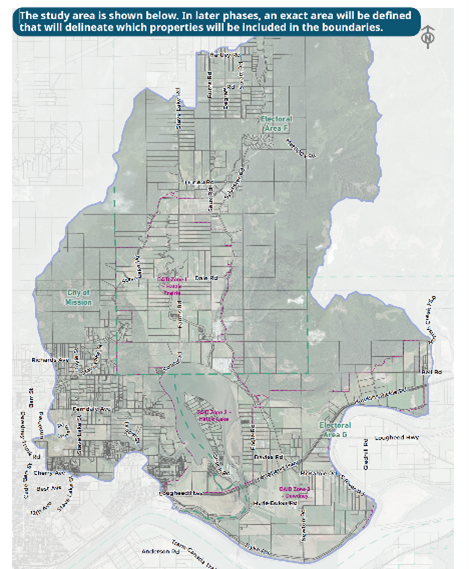
The study area is shown in the graphic below. In later phases of the project, an exact boundary will be defined that will delineate which properties would be included in the boundary (if developed).
What could the proposed approach in Option 3 look like?
Option 3 is a coordinated partnership between the Fraser Valley Regional District, Leq’á:mel First Nation, the City of Mission, and DAID — not a new organization, but a framework built through agreements to guide shared services, responsibilities, and decision-making.
There could be two main bodies:
It could be funded in two ways:
Current flood protection taxes focus on local infrastructure, which makes it very difficult to address the upstream issues that contribute to flooding in the valley. A broader, watershed-wide approach allows everyone — including those within the DAID area — to contribute to solutions that reduce downstream impacts and support other flood mitigation benefits. By investing in better planning, coordination, and climate preparedness now, we can lower long-term costs, strengthen resilience, and protect the valley more effectively.
Without a shared model, each agency would shoulder flood management independently, potentially adding costs to maintain current capacity.
For more details on Option 3 being proposed, download the Project Overview Package and Open House Boards (2026) by clicking here, or through the documents tab.
How will my feedback be used?
We are collecting feedback on all three governance options. We want to know thoughts and concerns for each. Your feedback will be used to inform each of the options and guide decision making on which (if any) to proceed with.